

SOS Plumbing Explains Local Water Reports, Home Filtration and Tankless Heaters
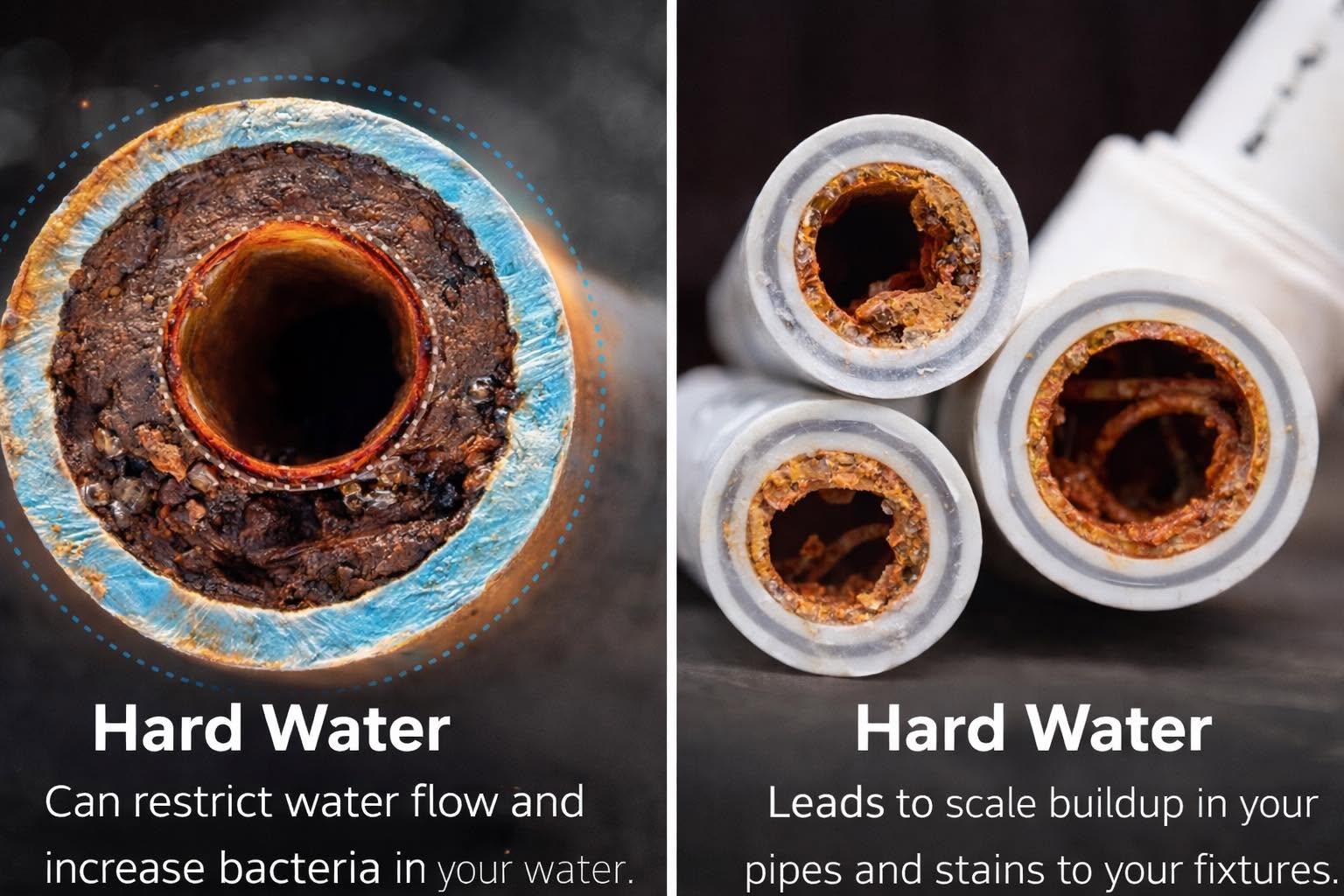
Mineral scale and corrosion can narrow the inside of water pipes over time, reducing flow and leaving stains on fixtures. Water conditions vary from home to home, which is why SOS Plumbing recommends testing before choosing treatment equipment.
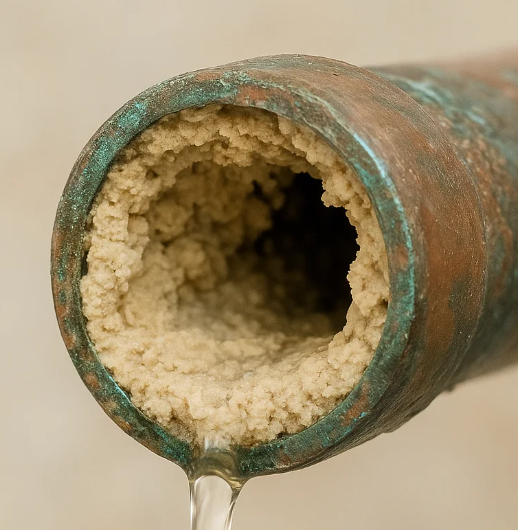
Hardness minerals such as calcium and magnesium can deposit scale inside copper supply lines, gradually narrowing the pipe’s interior.
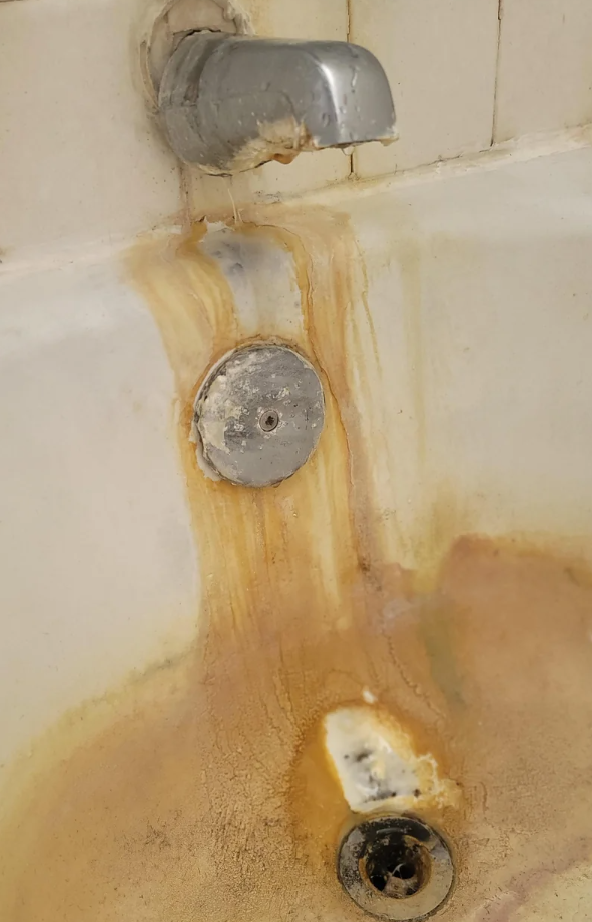
Orange and rust-colored stains on tubs, sinks and drains are often linked to iron in water. An in-home water test can help identify the cause before a homeowner selects filtration or softening equipment.
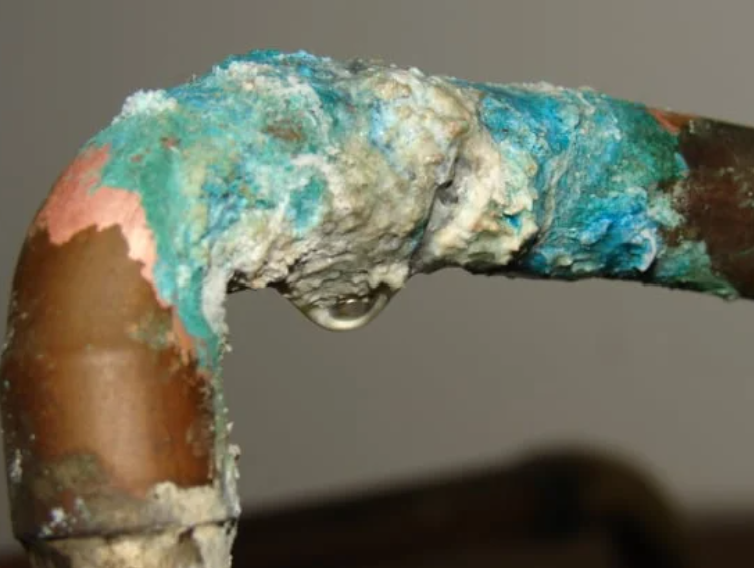
Green and white crusting on copper plumbing is a sign of corrosion and mineral deposits. Corrosion of household plumbing is the primary source of copper in drinking water, according to local utility water quality reports.
SOS Plumbing is a locally owned plumbing company based in Ward, Arkansas, offering in-home water testing, water treatment and water heater services.
Ward-based plumber reviews Cabot, Ward and Austin water quality reports and explains home filtration, water softeners and tankless water heater efficiency.
SOS Plumbing’s position is that equipment decisions should start with information. A utility’s annual drinking water quality report describes the water leaving the treatment plant and moving through the distribution system. An in-home test describes the water coming out of a specific faucet. Used together, the two sources give homeowners a factual basis for deciding whether they need filtration, softening, a water heater upgrade or no new equipment at all.
The public water systems serving these communities meet federal drinking water standards, according to their most recent published reports. Those same reports also show that local tap water often comes from blended sources, is disinfected with chlorine, and can pick up materials from household plumbing that utilities do not control. Those are the conditions home water treatment is designed to address.
In-Home Water Testing in Lonoke County
According to SOS Plumbing, the company has now performed more than 100 water tests inside customers’ homes. In-home testing measures water at the point where a family actually uses it, after it has traveled through the home’s own service line, pipes, fixtures and any existing treatment equipment. That distinction matters because conditions at an individual tap can differ from the utility’s sampling locations, particularly in older homes or homes with aging water heaters and plumbing components.
The results of an in-home test help determine whether a household’s concerns are aesthetic, such as taste, odor, staining or scale, or whether further evaluation is warranted. For some households, the findings point toward a water softener. For others, a point-of-use filter at the kitchen sink is the better fit. In some cases, the results show that no additional treatment is needed.
In-home screening tests are a practical first step, but they are not a substitute for certified laboratory analysis when a specific health-related contaminant such as lead is suspected. Homeowners with that concern can arrange testing through a certified laboratory, and the utility reports themselves list contact information for questions about testing.
Where Central Arkansas Tap Water Comes From
Many homes in this part of Lonoke County receive a mix of groundwater and surface water. Ward Utilities’ 2025 Annual Drinking Water Quality Report states that the city pumps from three wells in the Alluvial Aquifer and also purchases water from the Lonoke-White Public Water Authority, which treats surface water from Greers Ferry Lake.
Cabot Water Works’ 2023 report, the most recent edition reviewed, lists six Alluvial Aquifer wells supplying a treatment plant in Cabot, supplemented by water purchased from Central Arkansas Water, which draws from Lake Winona and Lake Maumelle. Austin Water Works’ 2025 report describes treated water purchased from Mid-Arkansas Utilities and the Lonoke-White Public Water Authority, with Central Arkansas Water and Jacksonville Water Works also part of the supply chain.
Blended supplies can produce noticeable differences in taste, odor and mineral content. Before treatment, groundwater from the Mississippi River Valley alluvial aquifer is described in U.S. Geological Survey research as generally hard to very hard and frequently high in iron. Hardness minerals are the source of scale that builds up on fixtures, inside pipes and within water heaters, while iron can stain sinks, tubs and laundry.
What Local Water Quality Reports Show
Disinfection byproducts are among the most useful figures for homeowners to review. When chlorine used to control microbes reacts with natural organic matter, it forms compounds including total trihalomethanes (TTHMs) and haloacetic acids (HAA5). The federal limit for TTHMs is 80 parts per billion (ppb), measured as a running annual average.
Cabot Water Works reported a highest locational running annual average of 64 ppb for TTHMs in 2023, with individual results ranging from 2.72 to 77.9 ppb. Ward Utilities reported a highest running annual average of 40 ppb in 2025, with results ranging from 13.1 to 63.8 ppb. Both figures are within the federal limit. For haloacetic acids, Cabot’s report lists a highest locational running annual average of 12 ppb against an enforceable limit of 60 ppb, and notes that the non-enforceable public health goal is zero.
Chlorine itself is the most common reason residents notice the taste and smell of tap water. Cabot Water Works reported an average chlorine residual of 1.09 parts per million in 2023, and Ward Utilities reported an average of 0.78 parts per million in 2025. Both are below the maximum residual disinfectant level of 4 parts per million. Chlorine is necessary to protect water as it travels through miles of distribution pipe, but many households prefer to reduce it at the tap where they drink and cook.
Nitrate, which can come from fertilizer runoff, septic systems and natural deposits, was reported at an average of 0.515 parts per million in Cabot and 0.13 parts per million in Ward, against a federal limit of 10 parts per million. Copper, which typically comes from corrosion of household plumbing, was reported at a 90th-percentile level of 0.246 parts per million in Cabot and 0.070 parts per million in Ward, compared with an action level of 1.3 parts per million.
The reports further note that some people, including infants, some elderly residents and people with weakened immune systems, may be more vulnerable to contaminants in drinking water and should seek guidance from their health care providers.
Lead and Household Plumbing
Lead is a separate consideration. Both utilities reported 90th-percentile lead results below 0.001 parts per million at customer taps, well under the federal action level of 0.015 parts per million. Each report also explains that lead in drinking water comes primarily from service lines and home plumbing components, which the utility cannot control. Results inside an individual home with older plumbing materials can differ from utility sampling sites.
The utility reports describe a simple precaution: when water has been sitting in pipes for several hours, running the tap for 30 seconds to two minutes before using water for drinking or cooking can reduce potential lead exposure. Boiling water does not remove lead. Homeowners who want to reduce lead at the tap should look for a filter specifically certified for lead reduction, and those who are concerned about lead should have their water tested.
Homes on private wells are not covered by these utility reports. Private well owners are responsible for their own water testing and treatment decisions, which makes testing especially important for rural properties outside municipal service areas.
How Home Water Filtration Systems Work
Home water treatment ranges from single-faucet filters to point-of-entry systems that treat all water entering a house. Independent certification is the most practical way to compare products. Filters certified to NSF/ANSI Standard 42 reduce aesthetic issues such as chlorine taste and odor. NSF/ANSI Standard 53 covers reduction of specific health-related contaminants, such as lead and certain volatile organic chemicals. NSF/ANSI Standard 58 applies to reverse osmosis systems, and NSF/ANSI Standard 44 applies to residential water softeners.
Certification applies only to the contaminants listed for a specific model, so a product’s performance data sheet is more informative than its packaging. Two filters can carry the same NSF/ANSI standard while being certified to reduce different contaminants. Filters also require scheduled cartridge replacement; a neglected filter can accumulate the material it was installed to remove.
Matching Treatment to the Problem
Different water conditions call for different equipment. Whole-house sediment filters are commonly used for particles and iron that stain fixtures and laundry. Point-of-use filters installed at a kitchen sink focus on the water a family drinks and cooks with, and certified models can address chlorine taste or lead. Reverse osmosis systems provide the broadest treatment at a single tap. Water softeners address hardness minerals rather than chemical contaminants, and they are often paired with filtration when a home has both scale and taste concerns.
Because each of these systems solves a different problem, installing the wrong one can leave the original issue unresolved. That is the practical reason SOS Plumbing recommends testing before purchasing equipment.
SOS Plumbing provides water softener and water treatment installation for homes and businesses, including sizing equipment to a household’s water use and hardness levels and tying new systems into existing supply lines to code.
Tankless Water Heaters and Energy Use
Water quality and water heating are closely connected. Hardness minerals deposit scale inside water heaters, which can reduce efficiency and shorten equipment life, and tankless units generally require periodic flushing in hard-water conditions. Treating hard water can help protect a new water heater investment.
Tankless water heaters, also called on-demand or instantaneous water heaters, heat water only when a tap is opened rather than keeping a storage tank hot around the clock. According to the U.S. Department of Energy, homes that use 41 gallons or less of hot water per day can see demand water heaters perform 24% to 34% more efficiently than conventional storage tank models. Homes with heavy hot water use, around 86 gallons per day, can see efficiency gains of 8% to 14%. The Department of Energy also reports that most tankless water heaters have a life expectancy of more than 20 years and avoid the standby heat losses associated with storage tanks.
Standby loss is the energy a conventional water heater uses to keep stored water hot when no one is using it. Eliminating that loss is the main source of a tankless unit’s efficiency advantage, which is why the largest percentage gains appear in households with moderate hot water use.
Tankless performance depends on correct sizing. Output limits how much hot water a unit can deliver at one time, so a household running a shower, dishwasher and washing machine simultaneously needs a unit sized for that combined demand. Gas-fired models generally provide higher flow rates than electric models. Fuel type, household demand, local building codes and venting requirements all affect which unit is appropriate. SOS Plumbing performs tankless water heater installation, repair and maintenance alongside conventional tank water heater service.
Questions Homeowners Can Ask Before Buying Equipment
Before purchasing filtration, softening or water heating equipment, homeowners can ask several practical questions. What did the most recent utility report show for disinfection byproducts, lead and copper? What did a test at the home’s own tap show? Is the concern taste and odor, scale and staining, or a specific health-related contaminant? Which NSF/ANSI standard and which specific contaminants is the recommended product certified for? How often will filters or media need to be replaced? For water heaters, how much hot water does the household use at peak times, and is the home’s gas supply or electrical service suited to a tankless unit?
Clear answers to those questions help homeowners avoid equipment that is undersized, oversized or aimed at the wrong problem.
Practical Steps for Lonoke County Homeowners
Homeowners can begin by locating their utility’s latest Consumer Confidence Report, which the Arkansas Department of Health publishes online by public water system number and which utilities provide on request. The system numbers listed on the reports are 338 for Cabot Water Works, 345 for Ward Utilities and 346 for Austin Water Works. Reviewing the disinfection byproduct, lead and copper sections, then pairing that information with an in-home water test and an assessment of the age and materials of a home’s plumbing, provides a factual starting point for deciding whether filtration, softening or a water heater upgrade is warranted.
About SOS Plumbing
SOS Plumbing, also known as SOS Plumbing & Rooter, is a locally owned plumbing company based at 175 Gray Road in Ward, Arkansas. The company is led by Brodie Stanley, a licensed and insured master plumber with more than 15 years of professional experience and provides 24/7 emergency service. SOS Plumbing serves residential and commercial customers in Ward, Cabot, Jacksonville, Sherwood, North Little Rock, Lonoke and surrounding Central Arkansas communities. Services include in-home water testing, water heater repair and replacement, water softener installation, leak detection, drain cleaning, sewer line repair, gas line work and commercial plumbing. The company holds license number 6889.
For more information, contact SOS Plumbing at (501) 941-8012 or visit https://sosplumbingandrooter.com/.
Brodie Stanley
SOS Plumbing
+1 501-941-8012
sosplumbin@gmail.com
Visit us on social media:
Facebook
Legal Disclaimer:
EIN Presswire provides this news content "as is" without warranty of any kind. We do not accept any responsibility or liability for the accuracy, content, images, videos, licenses, completeness, legality, or reliability of the information contained in this article. If you have any complaints or copyright issues related to this article, kindly contact the author above.
